

This is the time of year when the evergreens shine, both in the landscape and worldwide in homes with celebrations around the time of the winter solstice. Evergreens brighten the often-dreary winter landscape when everything dormant appears dead. In some cultures, these green trees have come to symbolize eternal life because of their ability to retain their needles or leaves during the shortest coldest days of the year. Due to their evergreen nature, these trees have also come to represent hope for the renewal of life in the spring.
The forests and landscape throughout Virginia are home to many diverse types of evergreen trees. The vast difference in the environment and the soil between the mountains and the sea provides growing conditions for a variety of genus. I love the fragrance of the Balsam Firs, Abies balsamea, and rare stands of these trees are growing naturally in the highest elevations of Hawksbill and Stony Man mountains in the Shenandoah National Park. Down the Blue Ridge, on Mount Rogers, hikers can find Red Spruce, Picea rubens, and Fraser Fir, Abies fraseri, growing only in the highest peaks. Understanding the need for cool, moist growing conditions and lush undergrowth, Virginia Christmas Tree Growers raise Canaan Firs, Abies balsamea var. phanerolepis. This tree is believed to be a cross between Fraser and Balsam Fir, retaining the scent of the Fraser Fir and the needle retention of the Balsam Fir.
A tree found naturally throughout Virginia is the Eastern Red Cedar, Juniperus virginiana. Growing in zones 2-9, this plant grows along most of the East Coast from Georgia to Maine. The Eastern White Pine, Pinus strobus, is planted throughout much of Virginia, but it naturally occurs in the mountains. Another evergreen that thrives in cool, moist areas is the Eastern Hemlock, Tsuga canadensis. While Virginia Pine, Pinus virginiana, loves the sun, Eastern Hemlocks tolerate shade well . Considered a pioneer species, Virginia Pine can be one of the first trees to inhabit a meadow, as well as Eastern Red Cedars. Shortleaf pines, Pinus echinata, are site specific, preferring to grow among oak trees in acidic soil in the lowlands, but the American Arborvitae, Thuja occidentalis, seek the sweeter soil of limestone bluffs. As adaptable as Eastern White Pine, this arborvitae can grow in acidic well-drained soils and is found in landscapes throughout the commonwealth.
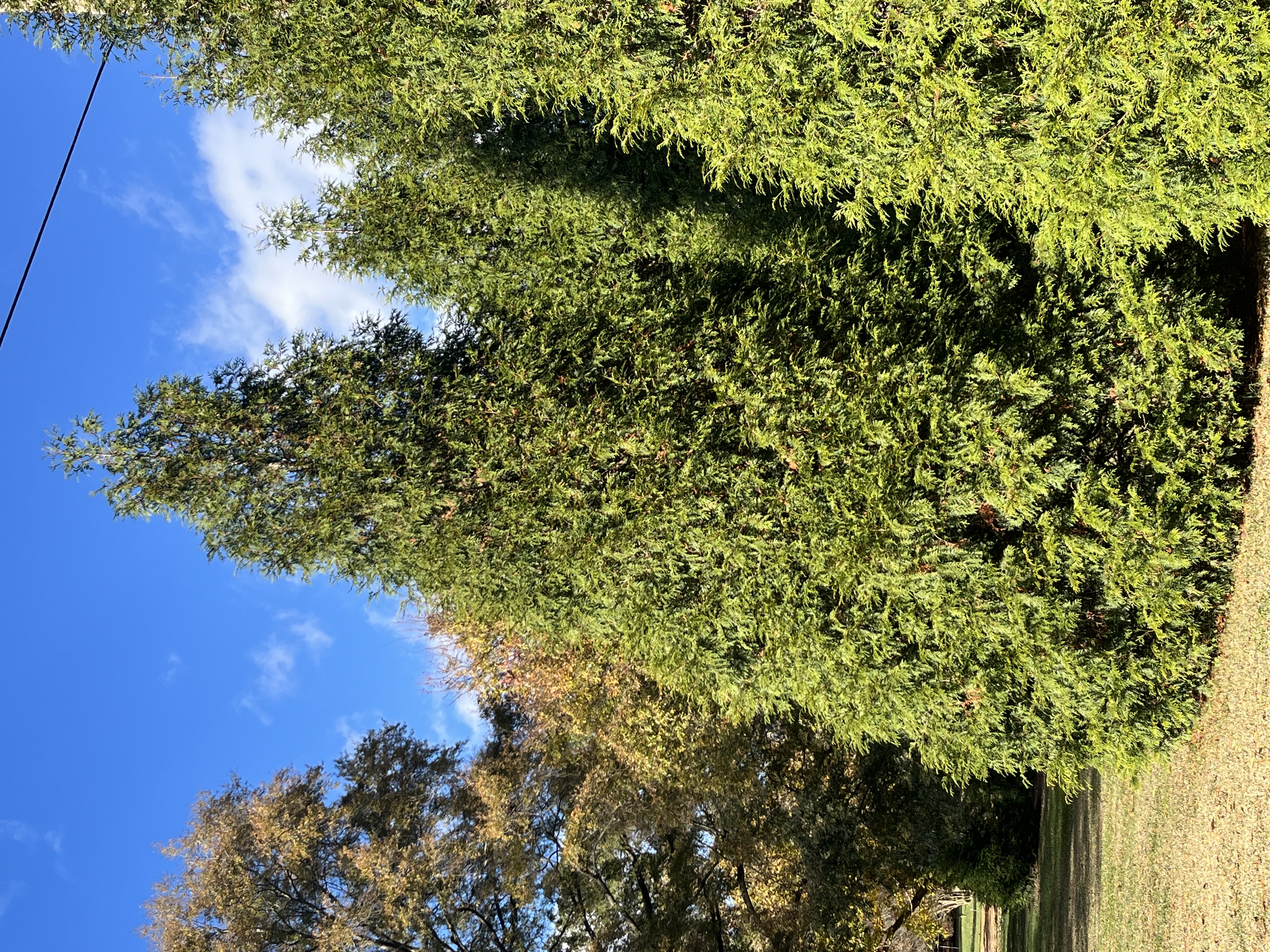
Due to where I live, the evergreen I encounter the most is Loblolly Pine, Pinus taeda. Growing from the piedmont to the coastal plain, Loblolly Pines naturally line the highways and byways and are farmed in endless rows as the leading timber tree in the Southeastern US.
Living in zone 7, I also encounter many broadleaf evergreens. In my yard, birds and I enjoy the red fruits of the female American Holly, Ilex opaca, each winter, although for two completely different reasons. I enjoy the beauty of the red against dark green spiny leaves, while the birds enjoy feasting on the plump red drupes, technically classified as fruit, not berries.
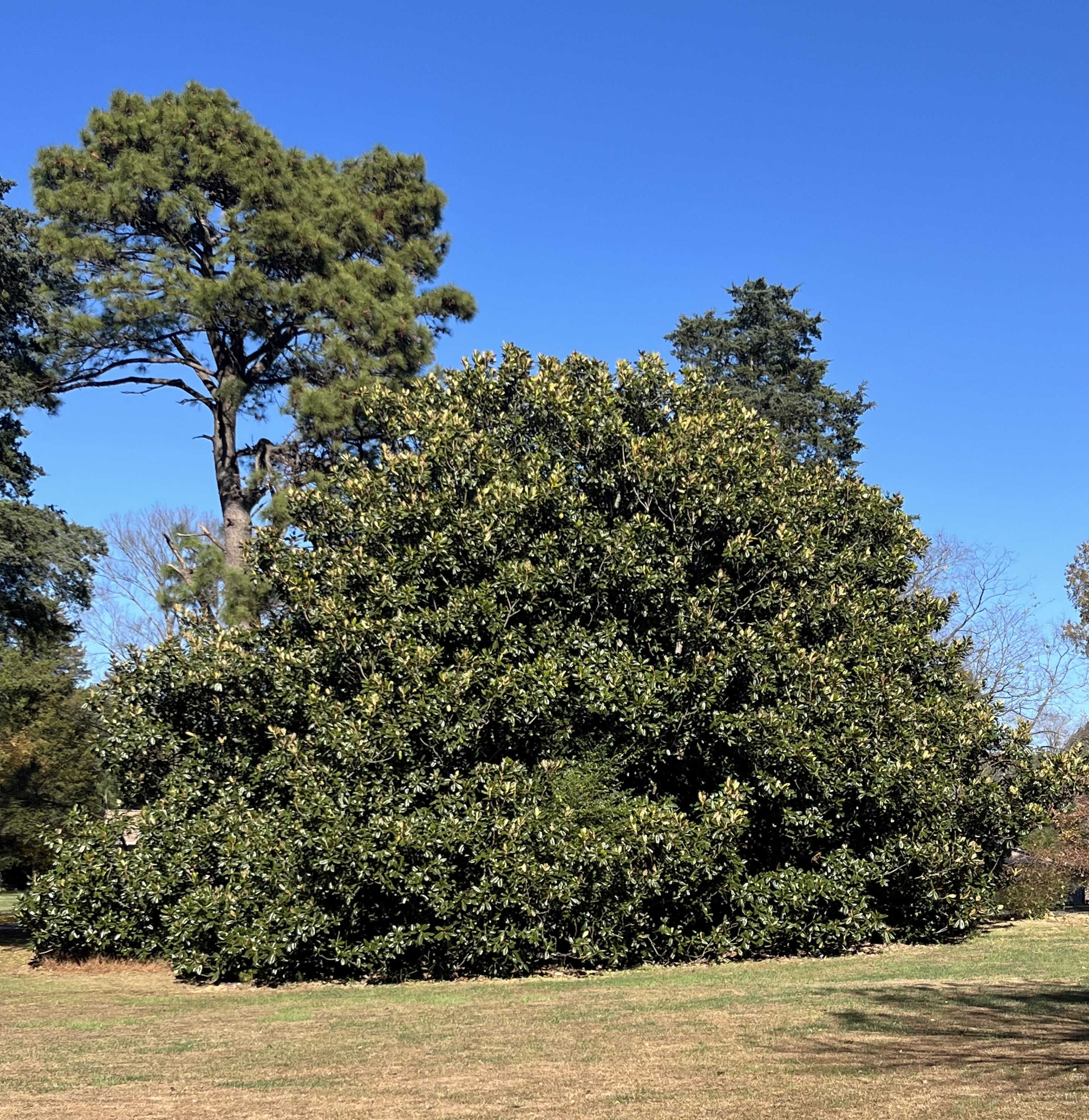
My final mention is the Southern Magnolia, Magnolia grandiflora. The large, glossy leaves of this large, broad tree shine in the winter sun. Cut branches of this tree are perfect for bringing indoors to remind us of the sweet scents of summer during the dark days of winter.
Happy Gardening!
Peggy
Resources:
The tree of peace: Symbolic and spiritual values of the white pine, informally referred, by H.W. Schroeder, 1993, in proceedings of the White Pine Symposium, p. 73-83, Sept. 16-18, 1992, Duluth, MN
Evergreen: A Holiday History, by Dan Buckler, Wisconsin DNR Forestry News, Dec 14, 2017.
The Natural Communities of Virginia Classification of Ecological Groups and Community Types, Version 3.3, VA Dept of Conservation and Recreation, March 2021.
National Capital Region Conifers, by John Parrish, National Park Service NCRN Natural Resource Quarterly, Winter 2011.
Campus Tree Tour, Loblolly Pine – Pinus taeda, University of Florida


